
The facts
- Vehicle: 2019 Mercedes-Benz G 550, VIN WDCYC6BJ3KX300395, US-spec, built July 16, 2018.
- The factory build requires Code F49 — heated windshield. It is on the vehicle's data card.
- The car is wired and fused for it: a dedicated heater fuse (F235, 20A), the N22/1 air-conditioning control unit that drives and monitors the heater, and the F49 harness — all present.
- The original windshield (A 463 670 25 00) showed the heated-glass signature: a blue-violet reflection from outside and interference with windshield-mounted transponders.
- The dealer replaced it with genuine Mercedes-Benz glass — part A 463 670 40 00 64, made by Vitro/PGW in 2024, the current supersession of the original. Authenticity and part number are not in dispute.
- The installed pane is plain laminated glass: markings M442 · AS1 · TRANSP 70%, with no heating, infrared, or Sungate designation.
- It shows none of the heated-glass signatures: no violet reflection at any polarized angle, no radio-permeable window by the mirror, no transponder interference, and no heat on defrost.
- On this car F49 heats through a conductive coating, and by its physics that coating must produce all three signatures at once — violet reflection, radio attenuation, and heat. They are one layer. The signature is absent, so the layer is absent.
- The heated original is discontinued. Mercedes now sells one windshield part for the G 550; the original heated number is no longer separately available.
The finding: the replacement is genuine Mercedes-Benz glass, correctly numbered — and not the F49 heated windshield the vehicle was built with. The factory feature is gone. What follows is the evidence, in order.
Treat it as an investigation, not an accusation. A car is built with a feature recorded as a three-character code on a document the owner never sees. Years later the glass breaks, the dealer orders the part the catalog returns, and a genuine, correctly numbered windshield is bonded into place. The build sheet still lists the feature. The new glass shows no sign of it. Whether the feature survived the replacement is a question the paperwork raises and only a diagnostic test can close — and that gap, between what the factory recorded and what the new pane appears to be, is the subject here.
1. Factory specification
Every Mercedes-Benz leaves the factory with a data card — internally, the VeDoc record — listing every option the car was built with as short codes. It is the vehicle's birth certificate, and it does not change. Read by VIN, this car's card lists, among roughly a hundred entries, the one that anchors this investigation:
Factory data card, decoded by VIN · WDCYC6BJ3KX300395F49 WINDSHIELD HEATED

Code F49 is a heated windshield: a distinct factory variant in which the pane itself carries a transparent, electrically conductive layer that warms the glass. The card also lists W72, heat-insulating dark-tinted glass — but that option applies to the rear privacy windows, not the windshield. And it does not list 596, the infrared-reflective "all-round" glazing other Mercedes models carry. That absence matters: the intuitive theory — that the owner lost an IR-reflective windshield — is not supported by the car's own build record. The documented feature is F49.
2. What was installed
The replacement glass is genuine. It carries the Mercedes star etched in the corner — the mark aftermarket glass cannot wear — and was manufactured in 2024 by Vitro, the company that absorbed Pittsburgh Glass Works' original-equipment business and stamps its glass with the DOT 904 code. The dealer's paperwork lists part A 463 670 40 00 64, which Mercedes catalogs confirm is the current windshield for this VIN. Its bug reads:
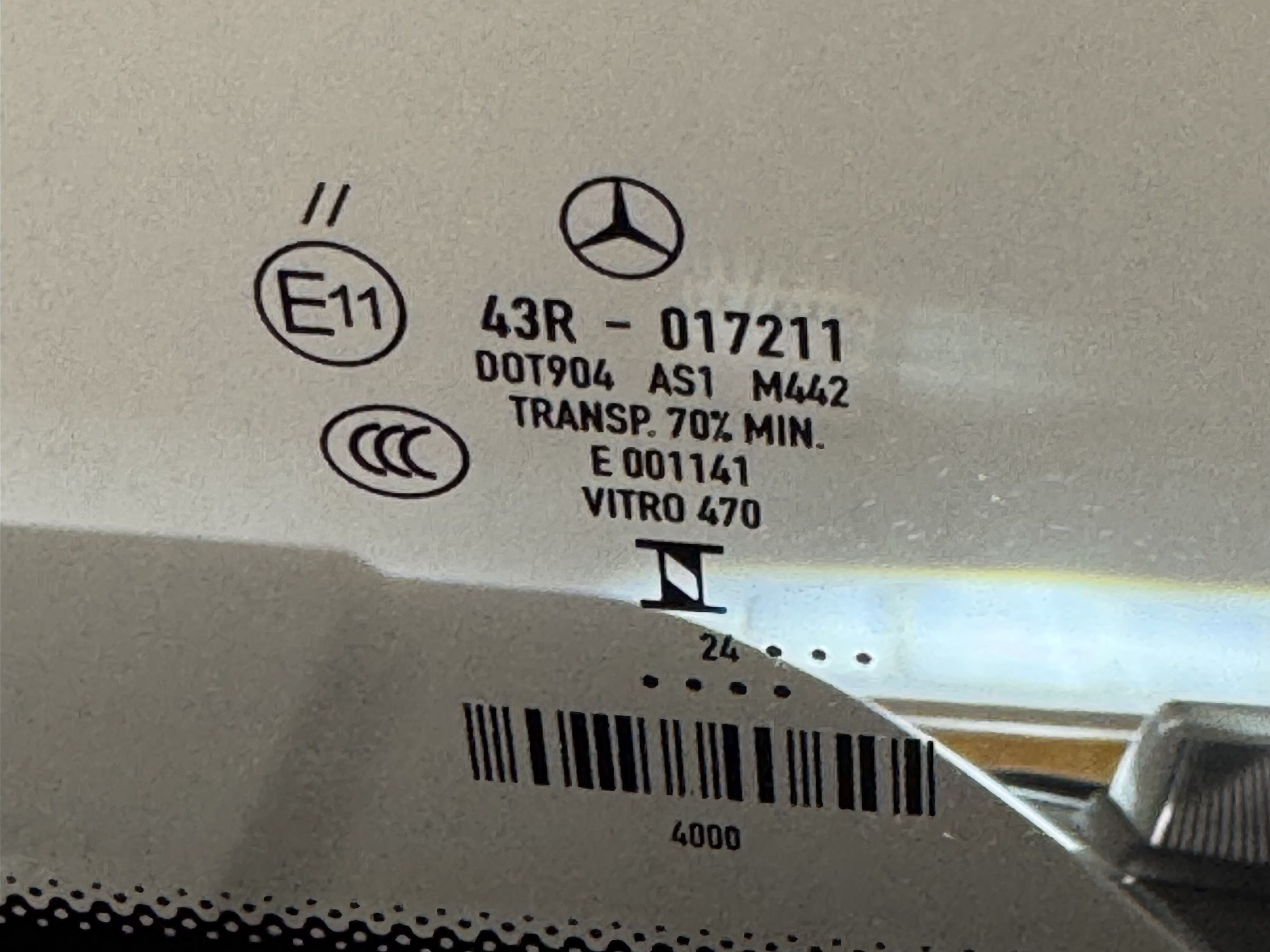
The glass is authentic and it is the right part number. Neither is in dispute. What the markings do not advertise — and what the rest of this investigation turns on — is the F49 heating layer the build sheet calls for.
3. Physical differences observed
The owner's account is specific and consistent. The original windshield threw a faint blue-violet reflection visible from outside; the replacement looks clear and neutral. Viewed through polarized sunglasses, the original showed the IR-style sheen; the replacement shows none. The small uncoated "communication window" typical of coated glass was not observed on the new pane, and the radio-frequency interference the original produced — the kind that affects a windshield-mounted transponder — was not observed either. Under defrost, the owner reports the glass no longer clears the way it did. These are observations, not yet instrument readings. They are recorded here as observations.
What makes them coherent is a mechanism. The new-generation G's F49 windshield heats through invisible silver conductive elements laminated into the glass rather than visible wires. G-Class owners describe a small grid just to the right of the mirror from which the heating elements fan out, and report that the layer behaves like a partial Faraday cage: radar detectors and transponders lose signal except in a small radio-permeable cutout, and there is no separate switch — the heater comes on automatically with full defrost. A thin conductive layer like that does three things at once: it conducts the current that warms the glass, it reflects light with a faint violet cast, and it attenuates radio signals. Glaziers identify the family by exactly that violet reflection and that signal behavior. If the conductive layer is the heating element, then the sheen, the transponder interference, and the heat are one feature — and their disappearing together is what an absent element would look like. That is a hypothesis the observations support; confirming it, rather than inferring it, is a diagnostic step, identified below.
4. Mercedes parts history
This VIN was built with windshield A 463 670 25 00. Mercedes has since consolidated that number, with three others, into a single current part — A 463 670 40 00 64, the one the dealer installed. In the catalog the old number is obsolete and the new number is its correct replacement. The dealer ordered exactly what the system returned.
That is the crux, and it is not a dealer error in the ordinary sense. A supersession collapses several earlier variants into one service part. When it does, the surviving part can fit and bond perfectly while differing from a specific original in a property the catalog no longer tracks against the build code. The right number can arrive as a different specification. The build sheet, not the parts catalog, is the record of what this car was meant to have — which is why the question is worth asking even though every step the dealer took was correct.
The wider context cuts both ways, and it is worth being precise about it. A long MBWorld thread documents an epidemic of cracked 2019 G windshields — the upright glass shatters readily, and replacements run $3,200–$3,500 and back-order from Germany for weeks. The same owners establish that the heated windshield is normal equipment on this car: standard on the Canadian-market G, a common option in the US, with owners routinely confirming theirs is heated. Against that backdrop, one owner, comparing his original to the replacement, remarked that the new glass "does not" have the defrost wires the original had. It is a single, unverified line — not proof, and plainly many replacements do arrive heated. But it is consistent with what this car's own evidence shows, and it is exactly the report that would multiply if a supersession quietly dropped the element. It is noted here as a lead, not a finding.
The dealer ordered exactly what the catalog returned. Whether the catalog's current part still carries the build sheet's feature is the open question.
5. What is proven
The verified facts, stated plainly:
- The factory data card for this VIN requires Code F49, a heated windshield. (Exhibit A.)
- The installed glass is genuine Mercedes-Benz, manufactured by Vitro/PGW, and its markings carry no heating or infrared designation. (Exhibit B.)
- The installed part, A 463 670 40 00 64, is the correct current supersession of this VIN's original windshield. Authenticity and part number are not in dispute.
- The car was not built with option 596; the infrared-glazing theory does not apply to this vehicle.
- The replacement visibly differs from the original in the ways associated with coated heated glass — the violet reflection and the radio behavior the owner reports losing.
One common shortcut is worth disarming, because it cuts both ways: the "M" code on the bug is not a feature indicator. A documented S-Class case shows an infrared original and its plain replacement carrying the identical M-number. Reading M442 as proof of anything about heating — present or absent — is an error. This investigation does not rest on it.
6. Formal confirmation
The finding stands on the documents and the observed physics set out above. These checks would document it on a dealer's own equipment, none requiring more than a service bay — the first is the decisive instrument reading:
- XENTRY resistance read at N22/1. The heated windshield is a measurable electrical circuit, not warm air — and Mercedes publishes the exact test. Bulletin LI67.19-P-074543 ("MY19+ G-Class: Windshield heater is not activating," dated 3/10/22), valid for the model 463 facelift from model year 2019 with code F49 through VIN end number …X410005 — a range that includes this car — instructs the technician to "read out the resistance value of the windshield heater from the actual values of N22/1," with a specified value of 0.8–1.3 Ohm, and to replace the windshield if the value is out of tolerance. A working F49 pane reads in that band; a pane with no element reads open or out of range. That number is the definitive confirmation, and the most important missing piece in the file.
- Electrical connector. A heated windshield is wired. Inspect the lower corners and cowl for a heater connector — and whether the vehicle's F49 harness now terminates in an unplugged connector behind the trim.
- Function. Under maximum defrost, observe whether the glass clears on its own or only where the vents blow.
- ADAS recalibration record. The windshield is the mount for the camera behind Distronic and lane-keeping, so a replacement makes a camera recalibration mandatory. The repair order should show that recalibration was performed and passed — and, if the new glass differs optically from the F49 original, it is worth confirming the camera calibrated against the correct optical assumptions rather than merely completing the routine.
- EPC footnote on the supersession. The catalog entry for A 463 670 40 00 64 should be read for any footnote governing the consolidation — whether it flags F49 as no longer supported, or calls for an additional sub-harness. This is a question to check, not a claim; but either answer would explain the gap, as a documented downgrade the customer was not told about, or an incomplete installation.
An official VeDoc data-card printout, which any Mercedes dealer can produce by VIN, would also formalize on dealer letterhead the F49 record the VIN decode already shows.
Why this matters
F49 is not a cosmetic detail. It is a functional cold-weather system specified on the factory build record. If the replacement windshield no longer contains the heating layer F49 requires, the vehicle has lost a documented factory feature — regardless of whether the installed part is genuine or an official supersession. "Genuine and correctly numbered" answers a different question than "matches what the car was built with." A paid repair is expected to return a vehicle to its specification, and the build sheet is the specification.
Two further stakes follow. The first is safety: the windshield carries the camera that drives Distronic and lane-keeping, so glass whose optical behavior has changed is not only a comfort question but an ADAS one — which is why the recalibration record belongs in the file. The second is financial. F49 glass costs materially more to manufacture than a plain pane, and if an insurer or the owner paid for an OEM heated windshield while the supersession delivered an unheated one, the amount paid and the feature received do not match — an open discrepancy in the claim, independent of how the dispute over the heating itself resolves.
On paper
The factory build, the installed glass, and the gap between them tabulate cleanly. The gap is the finding — and the last row is the test that closes it.
| Measure | Factory build (data card) | Installed glass |
|---|---|---|
| Heated windshield (F49) | Required | Not indicated · unverified |
| IR-reflective glazing (596) | Not equipped | Not present |
| Rear privacy glass (W72) | Equipped | Untouched |
| Genuine Mercedes glass | — | Yes (star etched) |
| Manufacturer | — | Vitro / PGW (DOT 904) |
| Original part number | A 463 670 25 00 | — |
| Installed part number | — | A 463 670 40 00 64 |
| Blue-violet sheen / coating signs | Present (original) | Absent (observed) |
| Heating function | Required | Absent — no coating signature |
Build-sheet column is the vehicle's factory data card, read by VIN. Installed-glass column is the markings etched on the replacement pane, the dealer's parts paperwork, and the owner's direct observations. "No coating signature" reflects the finding below: the conductive heating layer's required optical and radio-frequency signatures are absent across independent checks. Supersession (A 463 670 25 00 → A 463 670 40 00 64) per Mercedes-Benz USA parts catalog.
The finding
The case resolves on the evidence already in hand. On this vehicle the F49 heater is a transparent conductive coating, not visible wires — established by the original glass's own behavior, by G-Class owner accounts of the invisible silver element fanning from a grid beside the mirror, and by Mercedes' own F49 retrofit, which supplies coated glass with printed busbars and a dedicated converter. A conductive coating cannot be present silently: by its physics it must reflect light with a violet cast, attenuate radio signals, and carry the heat — one layer, three signatures. On the original windshield, all three were present. On the replacement, the owner found none: no violet reflection at any polarized angle, no radio-permeable communication window, no transponder interference. The heating layer and its optical-electrical signature are the same thing; the signature is absent across independent checks; the layer is therefore absent.
The conclusion follows without a scan tool. The replacement is genuine Mercedes-Benz glass, correctly numbered — and not the heated (F49) windshield the vehicle was built with. The single alternative that could rescue a heated reading, a wire-type element that throws no sheen, is ruled out: the original glass on this car visibly carried the coating signature, so the F49 system here is the coated type, and the coated type's signature is gone. A XENTRY resistance read at the N22/1 control unit would document this finding on the dealer's own equipment; it would not change it. The paid repair returned the vehicle below its factory specification. The remedy is restoration of the correct F49 glass, or refund of the work.
Methodology & sources
The vehicle's equipment codes (F49, W72, the absence of 596) were read from its factory data card, decoded by VIN; the same record is held in Mercedes' VeDoc system, which any dealer can print. Part identity and supersession were taken from Mercedes-Benz USA's public parts catalog entry for A 463 670 40 00 64. Glass authenticity and manufacturer were read from the markings etched on the installed pane (Mercedes star; VITRO 470; DOT 904; AS1; M442). The mechanism of coated heated windshields and the M-code misconception are documented in the linked Mercedes owner-forum threads and glazing-trade references; the existence and storage of factory equipment codes is documented in the Mercedes-Benz developer materials for the Vehicle Datacard API. Visual and operational differences between the original and replacement glass are the owner's direct observations and are identified as such; the heating function has not yet been confirmed by diagnostic test. Every external claim is hyperlinked inline to its primary source. This investigation concerns a single vehicle and makes no general claim about Mercedes-Benz windshield replacements beyond it.